
How Unistrut Accessories Simplify Pipe and Cable Installations
In modern construction, electrical installations, and mechanical engineering, success depends on speed, versatility, and strength. While traditional framing systems require time-consuming welding, precise drilling, and unforgiving permanent modifications, Unistrut framing systems offer a better alternative.
First heavily utilized during the postwar construction boom, Unistrut provides a modular, reconfigurable, and incredibly robust solution for today’s structural needs. Whether you are suspending heavy conduit, building laboratory medical grids, or setting up solar panel racks, understanding how these systems work and selecting the correct Unistrut accessories is key to a successful build.
What Unistrut Systems Are and How They Work
At its core, a Unistrut, or strut channel system is a standardized structural framing system used for support, bracing, and anchoring. Originally pioneered in the 1920s by the Unistrut Corporation, the term today has become a synonym for metal framing channels, considering its universal application.
The system is built around cold-formed metal channels, each with an open slot on one side. The edges of this open slot fold inward, creating an internal lip. This unique profile allows users to attach a variety of Unistrut channel fittings, brackets, and clamps along the length of the channel without drilling a single hole.
The widespread use and popularity of the Unistrut system lies in its simplicity, consisting of three main components – struts, Unistrut nuts, and bolts. When inserting a channel nut into the channel and twist it 90 degrees, the nut grooves lock it firmly against the channel’s inward lips. Inserting a bolt into the nut through compatible brackets and fittings ensures the nut sits securely against the lip, creating a high-strength, non-slip mechanical connection. Since nuts can slide at any point along the length of the strut channel before tightening, the system provides endless adjustability in connections that can be easily modified, or dismantled, using only basic hand tools.
The Role and Types of Unistrut Accessories
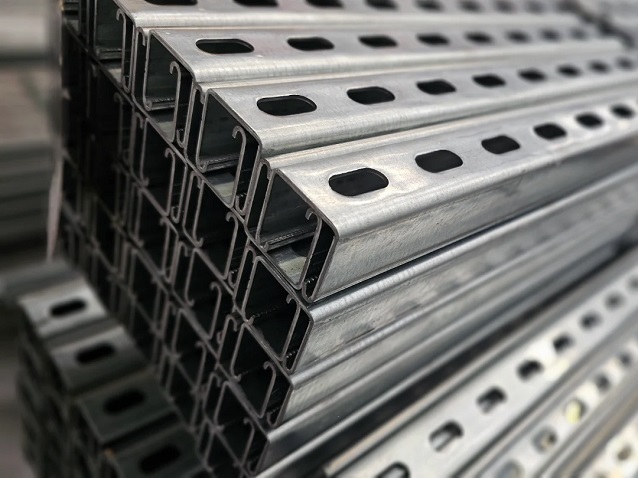
While strut channels provide the framing backbone, the system’s true versatility comes from its extensive ecosystem of accessories. Accessories dictate how the Unistrut system conforms to application needs, allowing it to bridge gaps, turn corners, and secure heavy loads. Common choices here include:
Channel Nuts and Hardware
- Spring nuts: Specialized spring-loaded channel nuts feature rectangular metal blocks with rounded ends designed to slot into channel lips. A central threaded hole, surrounded by serrated teeth and a bottom flexible metal or plastic spring attachment, pushes the nuts against the channel edges and secures framing in vertical and overhead installations.
- Stud nuts (male spring nuts): These features a pre-attached threaded stud or bolt pointing outward instead of a threaded hole. This is inserted and locked into the channel, leaving the protruding stud ready to push through a bracket or fixture hole and secure with a standard hex nut. The setup speeds up installations where holding a bolt in place while threading a nut from the front is awkward or tight.
General Fittings and Brackets
- Flat plate fittings: Flat-plate fittings form a weld-free, secure 180-degree connection. Supplied as 2-,3- and multi-hole varieties, flat plate fittings allow connecting of intersecting or parallel channels, splicing and extending channels. They can also provide the foundation for drop-downs.
- Angle fittings: 90-degree, 45-degree and adjustable angle brackets create right-angle connections between vertical and horizontal channels. They’re also used when connecting channels to other surfaces, such as walls and to strengthen existing framing systems with diagonal bracing.
- Wing-shape fittings: These are primarily seen in complex, multi-plane connections, such as wrap=around corners, bent tees and gusseted double corners, often as load-supporting elements in HVAC systems and to distribute the load of heavy fixtures across multiple channel holes.
Pipe and Conduit Clamps
These attach, stabilize and support pipes, tubes and electrical conduits. Common options are standard two-piece strut clamps, rigid/IMC clamps, EMT thin-wall clamps, U-bolts, saddle clamps, and rubber-lined cushion clamps. Unistrut pipe clamps can be optioned in a variety of materials, ranging from galvanized and hot-dip galvanized to 304 and 316 stainless steel and aluminum, used primarily in rigid and intermediate metal conduit runs, to hold gas and water lines and to isolate copper and refrigerant lines in HVAC systems.
Beam Clamps and Base Plates
Beam clamps anchor Unistrut channels directly onto structural girders and I-beams. They also combine with cantilever arms, angle fittings, and channel couplers to build heavy-duty machinery stands, equipment skids, and support tables. Post bases are heavy plates welded to a short channel socket, allowing Unistrut columns to be bolted directly into concrete floors or walls.
Key Benefits of Unistrut Systems
Compared to traditional framing methods, Unistrut assemblies eliminate the need for cutting, welding, grinding and painting steel. Moreover, the unique channel design allows for infinite adjustments, making installation incredibly fast and cost-effective.
When paired with specialized accessories, such as channel nuts, pipe clamps, brackets, and base posts, these systems become highly adaptable frameworks for electrical conduit, HVAC ducting, and plumbing. The components lock securely into place using standard hand tools, enabling quick on-site modifications. Ultimately, Unistrut and its ecosystem of accessories provide a reusable, high-load capacity solution that saves labor costs while ensuring long-term structural reliability.



About Author

alex
?You can always edit a bad page. You can’t edit a blank page. Likes: ❤️ Beer ?, Pizza ? Dislikes:? Mice?, Barber ? Favorite song: ? Hurts - Wonderful Life